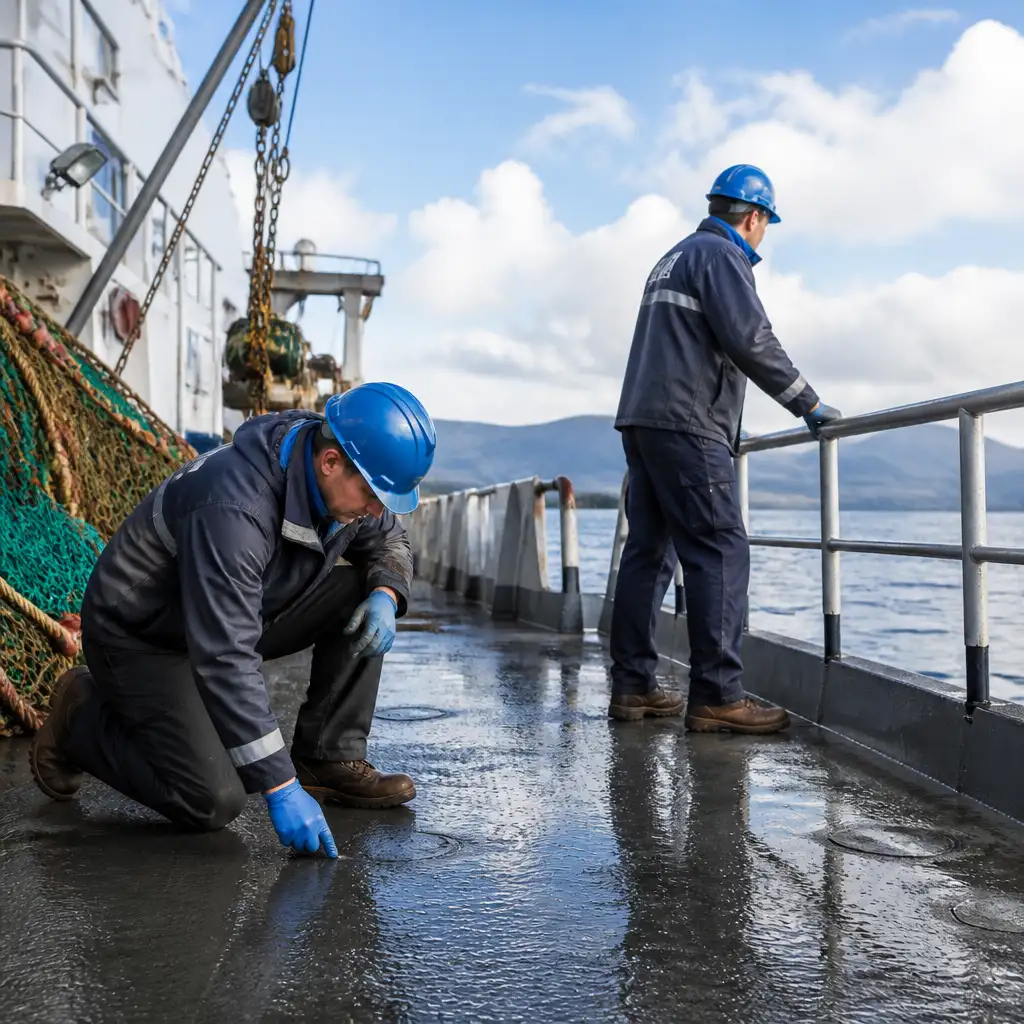
Deckhand falls remain a leading cause of injury aboard commercial fishing vessels, affecting operational readiness, regulatory compliance, and crew welfare. Understanding how human factors—fatigue, task design, communication breakdowns, and improper use of personal protective equipment (PPE)—converge to create slip, trip, and fall incidents is essential for owners and skippers who must manage daily safety risks in a dynamic marine environment.
This article examines common human-factor contributors to deckhand falls in the context of commercial fishing operations and provides practical administrative and engineering controls that can be implemented on small and large fishing vessels. The guidance emphasizes operational practicality, regulatory alignment with USCG expectations, and measurable risk reduction strategies that integrate into existing safety management systems (SMS).
Readers will find action-oriented recommendations suitable for vessels operating from nearshore to offshore waters, with attention to maintenance, crew training, watch schedules, and physical changes to deck layout and equipment. The objective is to improve marine safety through methods that are feasible at sea and during dockside maintenance periods, while supporting ongoing marine risk management efforts.
How fatigue increases fall risk on deck
Fatigue is a primary human-factor contributor to slips, trips, and falls aboard fishing vessels. Long watches, repetitive tasks, disrupted sleep from vessel motion, and early morning departures reduce situational awareness and impair balance and reaction time. Fatigue-related errors often present as slow responses to footing loss, misjudging footing on a wet deck, or attempting risky movements to complete a task quickly—all of which increase the probability of a fall.
Physiologically, fatigue affects vestibular function and fine motor control, both critical for negotiating a heaving deck. Cognitive strain reduces hazard recognition: a fatigued deckhand may miss a deck hatch left open, overlook steps over deck gear, or fail to secure a line before crossing a cluttered workspace. The cumulative effect of interrupted sleep cycles and long work periods is frequently underappreciated in routine vessel operations.
Operational controls that address fatigue should be part of a broader fatigue management plan that integrates watch scheduling, task rotation, and documented rest periods. Coupling administrative measures with training on fatigue recognition and simple monitoring—such as mandatory rest logs or supervisor checks during extended trips—can materially reduce incidents linked to tiredness and impaired judgment.
Task design and deck layout hazards
Task design and deck layout are engineering-level contributors to fall risk. Common issues include workstations crowded by equipment, hoses and lines routed across walkways, poorly marked level changes, and insufficient non-skid on frequently trafficked paths. On fishing vessels, wet and slimed surfaces are routine; when combined with poor layout, the deck becomes a predictable hazard.
Tasks that require one-handed work, elevated reach, or moving heavy gear while navigating narrow passages amplify exposure. For example, setting or hauling gear often forces deckhands to compromise stable footing to control a line or operate a winch. Where possible, redesigning tasks to allow two-person handling, staging gear to eliminate obstructions, and creating clear, dedicated walkways can reduce slips and trips.
Regular deck audits—performed during dockside maintenance and as part of at-sea checks—help identify layout deficiencies. Use findings from these inspections to prioritize engineering fixes that reduce reliance on human compensations, such as installing dedicated line channels, guardrails at edges, and permanently affixed non-skid in high-wear areas.
Communication, supervision, and teamwork failures
Communication breakdowns are a common human-factor failure in fast-paced fishing operations. Poorly timed orders, unclear hand signals, and lack of standardized callouts can lead to unexpected crew movements and collisions that result in falls. In low-light conditions or during high sea states, the absence of agreed signals amplifies risk.
Supervision plays a role as well. Inexperienced deckhands need close supervision when performing high-risk tasks such as working near the rail during hauls, stepping on or off gear, or moving over unstable swamped decks. Supervisory oversight ensures that established procedures are followed and that on-the-spot corrections are made before a minor error escalates to an injury.
Standardizing onboard communications—brief pre-task briefings, explicit roles for each action, and use of simplex verbal commands or hand signals—reduces ambiguity. Incorporating these standards into training and drills reinforces predictable crew responses, which is particularly important when crews are rotated or temporary personnel join the vessel.
PPE, clothing, and footwear factors that matter
PPE selection and use are frequently misunderstood contributors to fall incidents. Improper footwear—worn soles, incorrect tread pattern, or boots not suited for wet deck conditions—degrade traction. Similarly, loose clothing or unfastened personal flotation devices (PFDs) can snag on deck fittings, causing a trip or impeding a quick recovery after a slip.
Correct PPE policy must be practical. Require deck-appropriate boots with oil- and slip-resistant soles that meet maritime standards and are inspected routinely for wear. Layering policies should balance thermal protection with freedom of movement; bulky jackets that restrict limb movement can inhibit balance recovery when a slip begins.
Training on correct donning and stowage of PPE, and a culture that enforces consistent use, reduces human variability in protective measures. Ensure spare PPE is available and that inspections for wear and degradation occur during vessel checks and before voyages to maintain operational readiness and compliance.
Administrative controls for skippers and owners
Administrative controls are often the most cost-effective and immediately deployable measures to reduce deckhand falls. A structured approach includes documented procedures for high-risk tasks, fatigue management policies, and routine safety briefings that emphasize hazard recognition and mitigation. Implementing a permit-to-work or task-risk-assessment process for non-routine or high-risk operations increases awareness and accountability.
Training is central to effective administrative controls. Invest in maritime-specific training programs that cover seamanship, safe handling of fishing gear, and situational awareness on deck. Practical onboard drills and mentoring for new crew improve skill transfer and ensure that procedures are practiced under realistic conditions. For formal training options, Marine Safety Consultants offers maritime training programs that can be integrated into your safety plan to standardize competency across crews. maritime training programs
Recordkeeping and routine review close the loop. Maintain logs of near-miss reports, incidents, and maintenance actions so that trends can be analyzed as part of ongoing marine risk assessments. Where patterns emerge—such as repeated slips near a hatch or during a particular operation—use that data to prioritize corrective actions and update procedures accordingly. Linking administrative measures to documented risk controls supports compliance and continuous improvement efforts and aligns with broader maritime compliance strategies.
Engineering and equipment controls to reduce slips and falls
Engineering controls change the physical environment to reduce reliance on human vigilance. Start with anti-slip surfaces: apply and maintain appropriate non-skid compounds on walkways, steps, and around workstations. Where feasible, use grit-based non-skid with documented maintenance intervals to ensure effectiveness in wet, oily conditions common to fishing decks.
Modify deck layout to separate walkways from work zones. Install fixed handholds and strategically positioned rails, and ensure lifelines and safety barriers are robust and well maintained. Retractable safety nets, toe-rails, and dedicated boot-wash areas reduce the transfer of slime and fish byproducts that make decks hazardous. For critical machinery, consider guarding and remote operation solutions that keep crew clear of pinch points and unstable positions during gear handling.
Equipment maintenance is a frequent root cause uncovered during marine casualty investigations. Schedule regular inspections and preventive maintenance for winches, deck fittings, and hatch covers. Documented vessel inspections and condition checks, integrated into pre-departure routines and dockside surveys, reduce equipment failure risks that can lead to unexpected deck conditions and falls. For structured inspection support, consider periodic vessel inspections to validate controls and identify latent hazards. vessel inspections
Frequently Asked Questions
Q: How can small-boat operators practically manage fatigue when crew resources are limited?
A: Smaller operations should adopt predictable watch rotations, enforce minimum rest periods between trips, and prioritize cross-training so tasks can be rotated. Shorter, more frequent rest breaks and pre-trip assessments of crew fitness can help. Documenting rest periods and using a simple fatigue checklist before high-risk tasks improves awareness and reduces pressure to continue working while impaired.
Q: Are there quick deck modifications that provide high benefit for fall prevention?
A: Yes. Applying durable non-skid to primary walkways, installing additional handholds near steps and rails, and re-routing loose lines away from circulation paths are high-impact, relatively low-cost measures. Prioritize areas identified through routine inspections or near-miss reports for immediate attention.
Q: What training topics most directly reduce slips, trips, and falls on commercial fishing vessels?
A: Practical seamanship focused on safe gear handling, proper PPE selection and use, hazard recognition during wet-deck operations, and communication protocols for high-risk tasks are most effective. Regular onboard drills and mentoring for new crew reinforce these topics. Integrating these subjects into formal maritime training programs provides consistency across crews and voyages. marine risk assessments can identify specific training needs tied to vessel operations.
Commercial fishing operations face unique safety, regulatory, and risk management challenges. Marine Safety Consultants works with vessel owners and operators to help improve safety and operational readiness. Call 508-996-4110 to learn more.