Introduction
Man‑overboard (MOB) incidents remain a leading cause of fatality and serious injury in commercial fishing. When a crewmember enters cold water, the combination of rapid cooling, impaired mobility, and the physical demands of recovery create a narrow window for successful rescue and medical stabilization. Addressing cold-water MOB risk requires operational planning at the vessel level, coordinated response procedures, and clear post-incident processes that consider both safety and claims exposure.
This article focuses on practical measures for commercial fishing owners, skippers, and safety officers: identifying hazards unique to fishing operations, selecting appropriate workwear and personal protective equipment, employing recovery techniques and hardware suited to small commercial vessels, and delivering on-board medical care for hypothermia and immersion injury. The guidance is grounded in maritime safety practice, regulatory expectations, and risk management principles relevant to U.S. waters.
Readers should expect actionable recommendations, references to relevant compliance and training resources, and integration of human factors with technical controls. The aim is not prescriptive regulation but to provide a framework operators can adapt to their vessel, fishery, and operating area.
Identifying cold-water man-overboard hazards on fishing vessels
Commercial fishing presents a dense hazard environment: slippery decks, heavy gear, trawl doors, outriggers, and frequent transfer tasks create many potential MOB triggers. Weather and sea state can change rapidly, reducing the time available for recovery. Identifying high-risk tasks—line handling at night, deck work in heavy weather, transfers between vessels or skiffs—allows operators to prioritize controls and direct supervision where it matters most.
Vessel-specific risk assessment should include layout and access analysis. Consider how freeboard, rail height, and deck clutter affect both the probability of a fall and the time to locate and recover a person. Use regular walk-through surveys and checklists during pre-trip inspections to flag obstructed muster areas, rigged but unsecured equipment, and potential snag points. These inspections support broader marine safety practice and feed into scheduled vessel inspections.
Effective hazard identification also requires reviewing operational history: near-miss logs, injury reports, and informal crew feedback. Integrating those observations into a formal risk register supports targeted mitigation measures such as engineering controls, administrative procedures, and focused crew training. For operators wanting structured assessment support, consider professional marine risk assessments to document hazards and recommended corrective actions.
Workwear and personal protective equipment for cold-water immersion
PFDs and immersion suits are fundamental layers of protection but must be selected and maintained to match the vessel’s operating profile. Inflatable PFDs are common in commercial fishing due to mobility and reduced entanglement risk, but operators should evaluate donning time, inflation reliability, and compatibility with harnesses. For cold-water fisheries, supplemental thermal protection—neoprene suits, flotation suits with integrated thermal layers, or multi-layered clothing systems—reduces early-stage cold shock and prolongs survival time.
Personal protective equipment only protects when in good condition and correctly worn. Implement a maintenance and inspection regime: check inflation canisters, crotch straps, reflective tape, and zippers before each trip. Train crew in quick donning, and ensure spare PFDs and immersion suits are accessible and stowed where they can be retrieved under stress or limited visibility. For operations requiring harnesses, ensure compatibility between fall-arrest gear and PFDs to prevent interference with buoyancy or movement.
Administrative controls such as work-rest schedules, buddy systems, and task-specific PPE policy reduce exposure. Document PPE choices in your vessel’s safety management procedures and incorporate equipment checks into voyage planning and pre-departure briefings. For validation and training on equipment selection and use, maritime training programs provide discipline-specific instruction relevant to commercial fishing crews.
Recovery techniques and equipment for commercial fishing operations
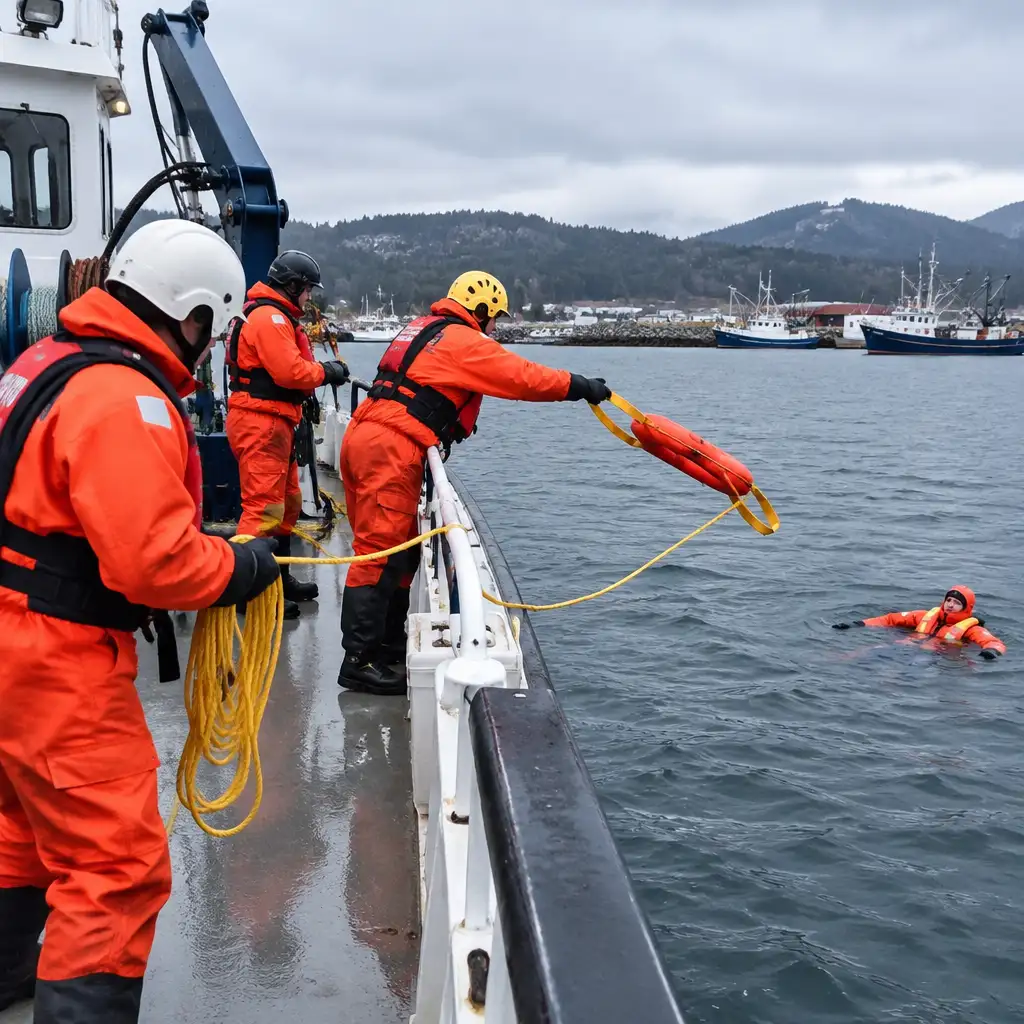
Recovery strategies must recognize the limitations of small commercial fishing vessels: limited deck space, restricted lifting gear, and often only a small crew to execute a rescue. Favor simple, robust equipment that supports fast location, containment, and hoisting when required. Examples include quick-deploy flotation aids, recovery slings with handles, heaving lines with weighted ends, and dedicated retrieval points on deck designed for securing lifting tackles or block and tackle systems.
Practice straightforward techniques that match vessel capabilities. Routine procedures include immediate stop and throw, heave-to while maintaining sight of the MOB, and deploying a flotation device with an attached marker. If the vessel carries lifting gear or a small crane, ensure rated recovery equipment and trained operators are available; rigging for a human lift requires certified slings and proper attachment points. For many operators, the most reliable method is a prompt approach-back strategy: maneuver to lee, recover over the stern using a retriever or strongpoint, and bring the person aboard from a stable platform or boarding ladder.
Recovery plans should address entanglement and injury risk: deck layout must provide space to manage lines, and winch operations should be halted before crew recovery commences. When using ladders or boarding nets, secure them to rated strongpoints and maintain clear communications between helm and deck. Equipment selection and placement should be validated during routine vessel inspections and incorporated into your safety procedures.
On-board medical response: recognizing and treating hypothermia
Cold-water immersion produces predictable physiological stages: cold shock, loss of motor control, swimming failure, and hypothermia. Rapid recognition and early intervention improve outcomes. Onboard, prioritize removing wet clothing, insulating the casualty, and preventing further heat loss. Initial response begins with getting the person out of the water and into a sheltered part of the vessel as soon as safe to do so.
Treatment priorities are airway, breathing, and circulation, followed by controlled rewarming. Passive rewarming—blankets, warm dry clothing, and shelter from wind—is appropriate for mild hypothermia. Active external rewarming (heated blankets, warm packs) may be necessary for moderate cases, but avoid rapid rewarming of extremities alone, which can drive cold blood to the core and worsen shock. Monitor for cardiac instability; hypothermic patients can experience arrhythmias when handled roughly or rapidly rewarmed.
Document the casualty’s condition, time in water, core temperature if available, and first-aid measures administered. This documentation supports both clinical handover to responding medical teams and later claims or investigative processes. For vessels operating far from shore, coordinate with shore-side medical advice and search and rescue (SAR) resources early; trained medical auditing and crew claims support services can advise on documentation standards and treatment timelines.
Training drills, human factors, and operational preparedness
Training is the most effective control for MOB risk reduction when combined with engineered and administrative measures. Regular man-overboard drills should be realistic, repeatable, and conducted in the operating environment. Drills must practice detection, immediate actions, recovery maneuvers, and post-recovery medical care. Include night drills and reduced-visibility scenarios to maintain crew competence across the range of operating conditions.
Human factors are central: decision-making under stress, communication clarity, role assignment, and fatigue management influence outcomes. Implement clear watchstanding protocols, ensure that roles are assigned during pre-trip briefings, and use standard communications phrases to reduce ambiguity during an emergency. Conduct after-action reviews following drills or incidents to capture lessons learned and update procedures.
Documented training and competency records are also an element of maritime compliance. Consider enrolling key personnel in formal maritime training programs that cover emergency response, hypothermia first aid, and vessel-specific recovery techniques. Coordination with shore-side training resources helps standardize procedures and supports continuous improvement through periodic audits and exercises.
Coordination with shore-side SAR and claims preparedness
Effective coordination with shore-side search and rescue (SAR) and emergency medical services begins before an incident. Maintain current communication plans with local Coast Guard sectors, know the appropriate VHF channels, and verify which SAR assets cover your operating area. Include emergency contact and rendezvous protocols in voyage planning and post them where the bridge team and deck crew can access them quickly.
While the person remains in the water, the captain must give the crew and recovery operation their full attention to support the safest and most efficient rescue. Answering USCG questions during recovery could distract the captain, who may not yet have the necessary answers. Where crew capacity permits, assign another crewmember to handle urgent radio communications so the captain can remain focused on directing the rescue. This must not delay a distress alert or a request for USCG assistance when needed.
After the person overboard has been recovered onboard, the vessel should contact the USCG to report the recovery, provide an update if contact has already been established, and coordinate any necessary medical assistance.
Post-incident, timely documentation and notification are critical for both regulatory compliance and claims management. Record environmental conditions, crew statements, equipment status, and time-stamped actions taken from detection through handover. These records support marine casualty investigations and assist in crew claims and medical auditing processes, particularly when evaluating medical costs, treatment timeliness, and potential preventive measures.
Engage external advisors for complex cases: incident investigation services can perform root cause analysis and develop corrective action plans, while crew claims support can guide medical auditing, cost containment, and legal exposure reduction. Preparing these relationships in advance—contracting consulting services and clarifying roles—reduces confusion and ensures a measured, evidence-based response when an MOB does occur.
Frequently Asked Questions
Q: What immediate steps should a skipper take when a crewmember falls overboard in cold water?
A: Initiate immediate shout and point, throw a flotation aid, assign a spotter, and maneuver the vessel to establish a lee and effect recovery using the method best suited to the vessel. Stop all winches and secure lines. Prepare for medical care by removing wet clothing and insulating the casualty once recovered.
Q: How often should man-overboard and hypothermia drills be conducted on a commercial fishing vessel?
A: Drills should be conducted regularly—at minimum quarterly—and after crew changes, major equipment modifications, or changes in operating area or season. Higher-risk operations may require monthly drills. Document drills and corrective actions for compliance and continuous improvement.
Q: What records are important for claims and investigation readiness after a cold-water MOB incident?
A: Maintain time-stamped incident logs, crew statements, equipment maintenance records (PFDs, immersion suits, retrieval gear), medical treatment notes, and photos of relevant equipment and deck arrangements. These records assist investigators and support medical auditing and claims management.
Relevant professional services can support operators in implementing these measures, including structured marine risk assessments, maritime training programs, and periodic vessel inspections to validate equipment and procedures. Integrating these services into your operational cycle strengthens both safety and compliance.
Commercial fishing operations face unique safety, regulatory, and risk management challenges. Marine Safety Consultants works with vessel owners and operators to help improve safety and operational readiness. Call 508-996-4110 to learn more.