Introduction
Enclosed‑space incidents remain a critical cause of preventable injuries and fatalities aboard commercial vessels. For vessel owners, masters, supervisory crew, safety officers, and shoreside managers, understanding the hazard profile of enclosed spaces and adopting robust prevention measures are core responsibilities of vessel safety and operations. This article outlines practical, non‑advocacy guidance for reducing enclosed‑space risk across a range of vessel types and operational contexts.
The guidance emphasizes prevention: hazard recognition, risk assessment, physical controls, ventilation, atmospheric testing, trained personnel, communications, and pre‑planned rescue arrangements. It avoids step‑by‑step entry or rescue procedures but sets expectations for what competent operational programs must include to reduce injuries and deaths.
Regulatory frameworks and recommended practices vary by flag, activity, and site. Where regulatory requirements are referenced, this article indicates the relevant authority (for example, U.S. Coast Guard (USCG), International Maritime Organization (IMO), or U.S. Occupational Safety and Health Administration (OSHA)) and points to guidance used to inform practical controls and verification. For incident review and learning, see established resources on marine casualty investigations.
What qualifies as an enclosed‑space hazard onboard
An enclosed‑space hazard on a vessel is a space that is enclosed or partially enclosed, has restricted means of entry and exit, and may contain hazards such as an unsafe atmosphere, engulfment, or mechanical/energy hazards. Typical examples on commercial vessels include cargo holds, ballast tanks, void spaces, double bottoms, cofferdams and voids, pump rooms with restricted access, refrigerated holds, engine rooms or machinery spaces with confined access, and sumps or ducts. On tank vessels, cargo tanks and associated cofferdams are primary enclosed‑space hazards; on fishing vessels, fish‑holds and brine tanks present similar risks but with different operational factors.
Different vessel types present different risk profiles. A tank ship’s cargo tank requires vapor control and inerting considerations not typical of a general‑cargo vessel’s hold; a commercial fishing vessel’s fish‑hold can accumulate carbon dioxide or ammonia from ice systems and decomposing catch. Passenger vessels may have service and void spaces that are rarely entered but must be controlled when work is required. Recognizing the space type, typical contents, and previous history is the first step toward targeted controls.
Spaces that are normally ventilated by routine operations but become enclosed during maintenance or cargo work (for example, an enclosed pump room during prolonged maintenance) should be flagged as temporary enclosed spaces and treated with the same rigor as permanent enclosed spaces during those periods. Maintain an up‑to‑date inventory of hazardous spaces and their known hazards as part of vessel safety records.
Atmospheric hazards and why senses can be misleading
Atmospheric hazards in enclosed spaces fall into three main categories: oxygen deficiency or enrichment, toxic gases and vapors, and flammable atmospheres. Oxygen levels below 19.5% are considered oxygen deficient and can incapacitate personnel; levels above 23.5% create a fire/explosion risk. Toxic gases commonly encountered aboard vessels include hydrogen sulfide (H2S) in tank and cargo residues, carbon monoxide (CO) from combustion sources, and solvent or hydrocarbon vapors in cargo or tank environments. Flammable gases and vapors (hydrocarbon vapors, explosive atmospheres) require strict control and monitoring.
Sensory checks—visual inspection, smell, or subjective impressions—are unreliable and unsafe as the sole basis for entry. Many toxic gases are odorless at dangerous concentrations; others deaden the sense of smell. Oxygen deficiency cannot be seen and may not produce noticeable odor. Regulatory guidance from authorities such as the USCG and international guidance from IMO both emphasize instrument‑based testing and continuous monitoring rather than reliance on human senses (see USCG and IMO guidance referenced below).
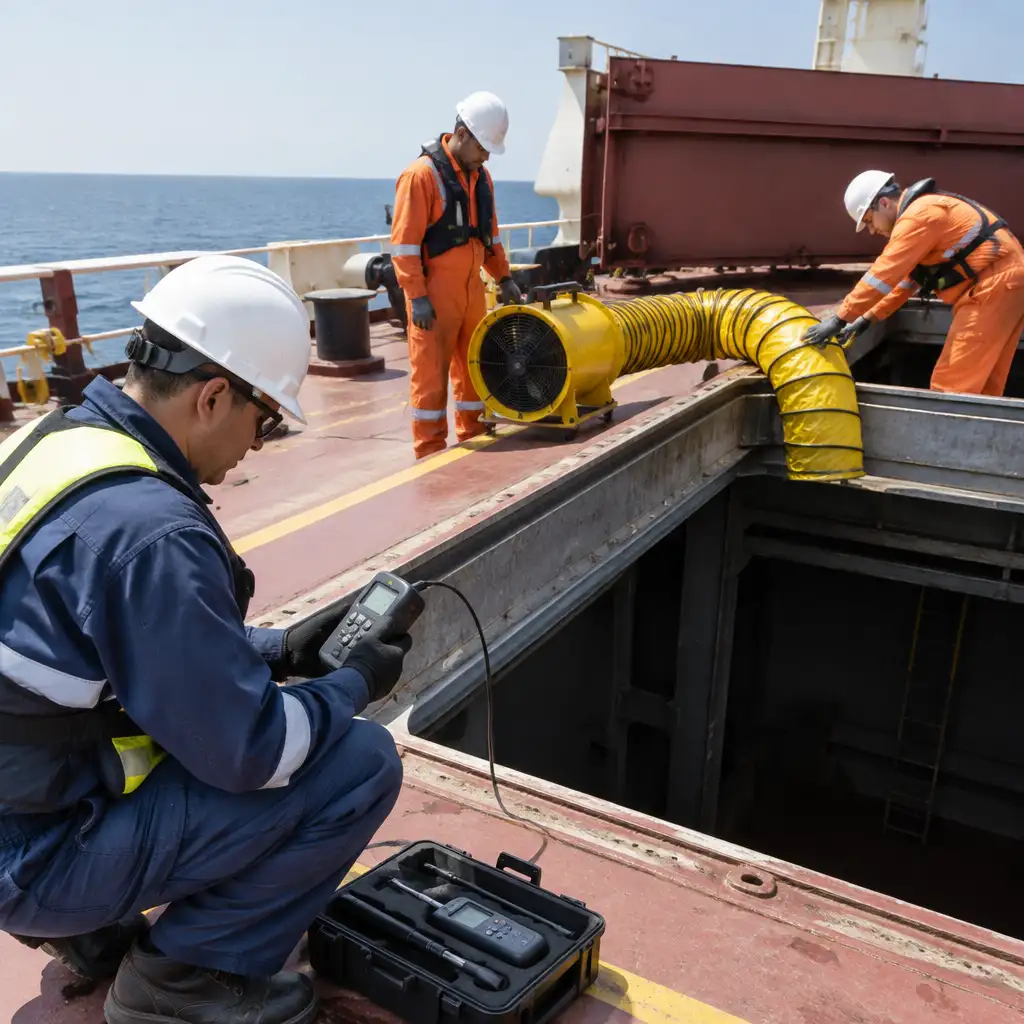
Use calibrated gas detection equipment that measures oxygen, LEL (lower explosive limit), and targeted toxic gases as appropriate for the space and cargo. Testing must be conducted before any exposure and continuously or at regular intervals during occupancy where conditions can change (for example, during cargo operations or hot work).
Common breakdowns between written procedure and practice
Many vessels maintain written procedures and permits for enclosed‑space entry, but persistent causal factors allow incidents to occur. Common breakdowns include inadequate practical training and drill frequency, staffing and watchstanding limitations that leave the attendant role unfilled, production pressures that shorten or skip required checks, poor communication and handovers between watches, complacency among experienced crews, superficial supervision that focuses on paperwork completion rather than competence, and a paperwork‑only culture where forms exist but controls are not implemented.
Operational realities can entrench these failures. For example, tight schedules during cargo operations may lead watchstanders to accept marginal testing results or to depend on a single portable meter without verifying calibration. Supervision that emphasizes throughput over safety contributes to the normalization of deviance, where unsafe shortcuts become accepted practice. Audit and inspection programs often find documentation in order while the practical controls were not consistently applied.
Addressing these gaps requires shifting from a compliance‑only mindset to practical competence: supervisors must observe and coach actual entry procedures, not only review completed permits. Use vessel inspections and safety audits to confirm that equipment is usable and procedures are followed in practice rather than only on paper; see recommended approaches for vessel inspections and audits to support this confirmation.
The risk of impulsive rescue and multiple casualties
One of the most dangerous patterns in enclosed‑space incidents is the impulsive rescue. An initial casualty in an enclosed space can quickly lead to multiple fatalities when unprotected coworkers attempt immediate entry to assist without testing, ventilating, donning proper PPE, or having rescue arrangements. Authorities and investigators repeatedly note instances where would‑be rescuers succumb to the same atmosphere as the initial victim.
Avoiding impulsive rescue requires clear crew expectations and accessible external rescue resources. Crew must be trained that an unprotected immediate entry is forbidden; instead, the watch should secure the scene, start ventilation if safe to do so from outside, notify command and shoreside support, and activate pre‑arranged rescue resources. For many flags and operations, guidance from USCG and IMO emphasizes calling trained rescue teams rather than attempting improvised internal rescues.
Operational mitigation includes pre‑identifying local emergency responders, ensuring crew rescue capability is practicable with appropriate PPE and equipment, and rehearsing the decision workflow so that the immediate reaction is containment and communication rather than entry. Successful prevention of multiple casualties depends on leadership, training, and muscle memory developed through practice drills.
Practical controls: risk assessment, permits, isolation, ventilation, testing, attendant, communications, and rescue planning
Core prevention elements are consistent across jurisdictions and vessel types, though implementation details vary. Key components are: documented risk assessment and an authorization/permit system; positive isolation and lockout of mechanical and energy sources; forced ventilation and verification of airflow; atmospheric testing and continuous monitoring; requirement for a trained attendant outside the space; reliable two‑way communications; and a pre‑planned, practiced rescue strategy. Each control must be documented and enforced by supervisory personnel.
Risk assessment should identify hazards specific to the space, vessel type, and activity, and define controls including required PPE, testing frequency, and ventilation rates. Permits or entry authorizations must be issued only after isolation and pre‑entry testing confirm safe conditions. Lockout and tagout of pumps, valves, and electrical systems should conform to the vessel’s safety management system and reflect the operational context (examples: isolating cargo lines on tank vessels or securing ventilation ducts in refrigerated holds).
Atmospheric testing must include pre‑entry multi‑gas checks (oxygen, LEL, and relevant toxics) and ongoing monitoring where conditions can change. Forced ventilation should be arranged to create positive airflow that removes contaminants and is verified by measurable airflow or continuous gas detector readouts. An attendant assigned outside the space must remain dedicated to monitoring the entrant(s), maintaining communication, and initiating rescue protocols if an alarm or emergency occurs. Communications should be redundant—hardwired intercom, intrinsically safe radios, or voice lines tested prior to entry.
Training, drills, documentation, and operator responsibilities
Training expectations: recurring, competency‑based, and practical. Crews must train on entry procedures, use and calibration of gas detectors, ventilation setup, attendant duties, communications checks, and staged drills that simulate reasonable failure modes (for example, sudden vapor generation or loss of communications). Training should include both classroom instruction and hands‑on exercises. Regulatory guidance commonly requires evidence of training and demonstration of competency; ensure training records are detailed and retained.
Every training session and drill should be documented with date, attendees, instructor, topics, and observed competencies. These records are essential for audits, regulatory inspections, and post‑incident review. Maintain training documentation in an accessible system and use the records to identify recurrent gaps or retraining needs; maritime organizations often integrate these records into their safety management systems or crew competence files.
Practical operator responsibilities include maintaining an accurate and current inventory of hazardous spaces, posting signage and controlling access, supplying and maintaining calibrated testing and ventilation equipment (regular calibration records and maintenance logs), assigning trained attendants and supervisors with adequate staffing levels, keeping procedures workable and clear (not just checkboxes), and actively supporting stop‑work authority when risks exceed controls. For regulatory alignment and compliance planning, integrate vessel procedures with applicable maritime compliance services and ensure shore management supports resourcing for safe operations.
Documented verification includes equipment calibration logs for gas meters and ventilators, permit archives, training and drill records, and incident or near‑miss reports. Regular safety audits and vessel inspections will help confirm that controls remain effective and equipment is serviceable; coordinate routine vessel inspections to identify degradation in controls before they contribute to an incident.
Frequently Asked Questions
Q: When does OSHA confined‑space guidance apply to vessels?
A: Applicability depends on the operation and jurisdiction. In the United States, OSHA’s general industry permit‑required confined space standard (29 CFR 1910.146) covers many shore‑side and some vessel maintenance operations; shipyard and longshoring activities are covered under separate OSHA standards (for example, 29 CFR 1915 and 29 CFR 1918). Vessel operators should consult flag‑state and port‑state guidance in addition to OSHA where relevant and align procedures with the applicable standard.
Q: How often should gas meters be calibrated and tested?
A: Calibration intervals depend on manufacturer recommendations, frequency of use, and exposure conditions. Practically, perform bump tests before each shift or before first use of the day and full calibrations at the interval specified by the manufacturer or company procedure. Keep calibration and bump‑test records for audits and post‑incident review.
Q: Who is responsible for deciding not to enter an enclosed space when production pressure is present?
A: Operational accountability rests with the master, the supervising officer, or the designated responsible person ashore depending on the vessel’s management system. Everyone with stop‑work authority must be empowered to halt operations or delay entry where controls are inadequate. Support for that decision from shoreside management and clear company policy is essential to ensure it is respected in practice.
Please contact us to discuss vessel safety assessment and training needs.
Ensure the utmost safety and compliance for your marine operations. For expert advice and comprehensive marine safety services, call us at 508-996-4110 or email tom@marinesafetyconsultants.com. Let’s prioritize your safety together.